Those students and professionals who intend to pursue their education or employment in another country prefer the computer-based IELTS exam. This type of exam consists of Speaking, which is conducted face-to-face with an interviewer, while other parts, such as Listening, Reading, and Writing, are completed on a computer. This IELTS writing method is very popular among students because of its contemporary format, flexibility in test scheduling, and fast delivery of results. Yet, mastering the skills of computer-based tests is as important as knowledge of English.
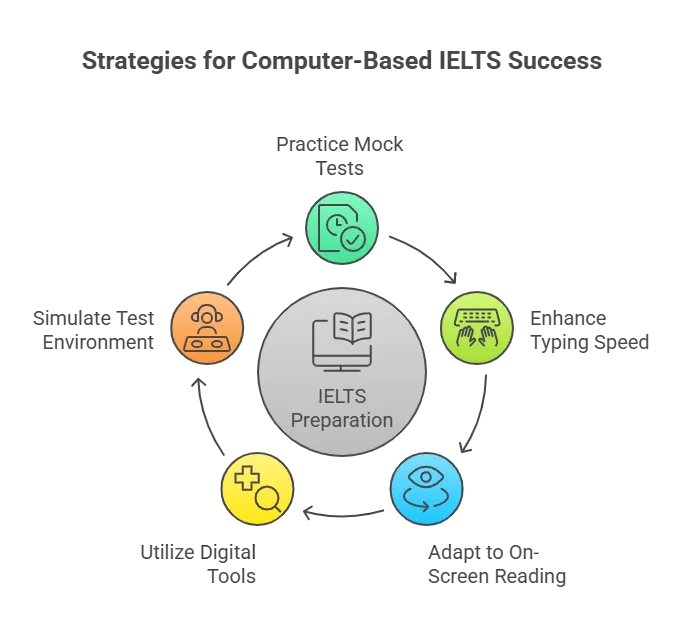
The candidates should become faster and more accurate by preparing properly for the Computer-Based IELTS exam. It is necessary to understand how the exam is conducted, to practice extensively on computers, and to learn to manage time efficiently.
Are you an aspirant preparing for the IELTS exam? Then join the Best IELTS center. Their expert trainers will help you achieve your desired band scores and fulfill your dream of moving abroad.
How to prepare for a computer-based IELTS exam
Understand the computer-based IELTS format
Knowledge of how the IELTS computerized test works should be the first thing in preparation. The listening, reading, and writing sections are completed on a computer using a keyboard and mouse. Test takers answer differently depending on their preferences; however, all question types are identical to those in the paper format.
It is crucial for candidates to learn how to use copy-paste options, navigate between questions, highlight text, and even manipulate the countdown timer displayed on the computer. This makes test stress manageable to a great extent.
Practice typing skills
As far as computer IELTS is concerned, typing speed becomes very important, especially during the Writing test. It may not be easy for those who type slowly to complete their essays within a stipulated period. Typing practice will reduce typing mistakes and make one fast.
It is recommended that you type your essays, letters, and other work on a computer every day. Being comfortable with your computer keyboard will enable you to save time during the examination.
Take online mock tests
One of the most effective ways to prepare for the computer-delivered IELTS examination is to take a variety of online practice tests.
These mock examinations help students become accustomed to the test format and build confidence for the actual test. Additionally, mock tests enable candidates to manage time effectively and find their weak areas.
Improve reading skills on screen
The process of reading passages on a computer screen might be distinct from that of reading books. It might be tough for students to focus for extended periods while reading from computers. The way to deal with this difficulty is to practice reading articles, newspapers, and IELTS sample readings on computer screens.
Techniques such as skimming and scanning will allow the reader to identify the answers within the shortest time possible. Highlighting is another important technique.
Strengthen listening skills
The candidates listen to audio passages using headphones while sitting at the computer-based IELTS Listening exam. Some English accents include British, American, Australian, and Canadian, among others, which learners ought to be familiar with.
Adaptation to the test environment will be more comfortable when learners practice wearing headphones during preparation. As they listen carefully to the audio, the learners should also develop their typing skills.
Focus on writing structure and accuracy
Candidates have to type essays and reports in the Writing component within a specified time period. Candidates need to focus on using grammar, vocabulary, and sentence construction correctly, as well as proper thought organization.
Candidates will be required to develop skills in rapid error correction and sentence improvement, as these processes are easier to perform on a computer. Practice in writing will help improve their performance.
Learn time management techniques
Time management plays an important role when writing the IELTS online test. The candidates must avoid spending too much time on difficult questions. Candidates who use a timer while practicing are likely to complete each section within the allotted time.
Effective time management in terms of reading questions, answering, and analyzing answers will improve performance. Moreover, there must be some time left at the end of the test for proofreading.
Build confidence with technology
Some learners get anxious taking computerized exams, especially when they rarely use computerized devices. Prior to taking the exam, learners must familiarize themselves with the exam format by practicing on a laptop or desktop computer.
Test-taking may become easier and less daunting when one can perform basic computer functions such as scrolling, selecting answers, typing, and navigating.
Maintain consistent preparation
One of the keys to success in preparing for the IELTS exam is to make a schedule for the speaking, listening, reading, and writing sections.
Revision, vocabulary building, grammar learning, and practice tests can lead to consistent score improvement. With practice, students may feel well-prepared for the exam.
Seeking an institute for PTE exam preparation? If so, then join the Best PTE Institute for PTE exam preparation under the guidance of expert trainers.
Conclusion
To prepare effectively for the computer-based IELTS exam, it is important to have a strong command of English, computer skills, and effective time management. The computer-based IELTS exam is a successful exam for test takers if they understand the format of the computer-based IELTS exam, practice typing, take computer-based practice tests, and improve their reading and listening skills on computer systems. Practicing and preparing help improve speed and accuracy, and help students achieve the desired band score in IELTS.



Leave a Reply