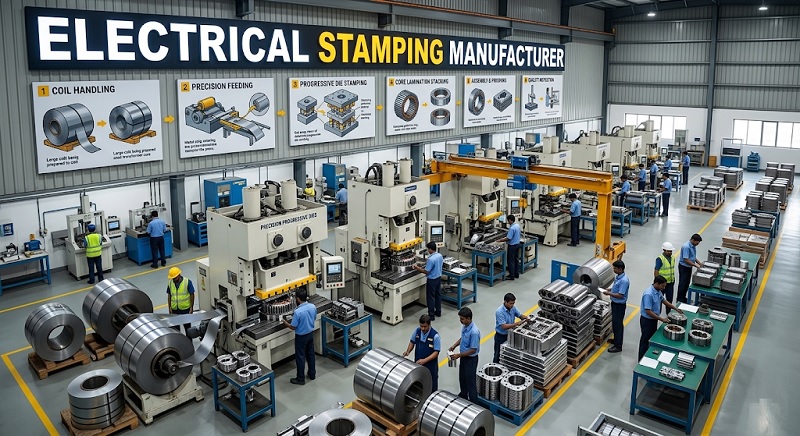
In the world of electrical systems, the role of an electrical stamping manufacturer has evolved as a crucial component in guaranteeing efficiency, reliability, and performance. Precision electrical stampings play a crucial role in a wide range of applications, from electric motors and transformers to automotive systems and industrial machinery, ensuring the efficient operation of modern manufacturing processes and technologies.
In addition to precision stamping, a number of industries also turn to Electronic Contract Assembly Companies to optimise production, guarantee quality management, and speed up the manufacturing procedure for big jobs. These services form an innovative manufacturing ecosystem that can address the needs of industrial automation, renewable energy and electric mobility.
What Is Electrical Stamping?
Electrical stamping or lamination stamping is a special type of manufacturing through high-speed mechanical presses that cut and form precise profiles from thin material of electrical-grade steel. The stamped laminations are joined together to create the magnetic cores of motors, transformers and generators.
The energy losses in laminated cores are greatly suppressed by the eddy currents, resulting in a much more efficient core than solid metal cores. Eigen Engineering is an experienced electrical stamping manufacturer, and engineers each lamination with precision to guarantee uniformity of their electromagnetic performance in each production run.
Core Materials Used in Electrical Stamping
The performance of any electrical stamped part is dependent upon the material used. As a committed electrical stamping manufacturer, Eigen Engineering produces on various high-quality steel grades, each of which has its own application:
- Silicon Electrical Steel (E-Steel): It is used for its low core loss and high magnetic permeability; suitable for motor and transformer.
- CRNO (Cold Rolled Non-Oriented) Steel: It has a constant magnetic characteristic in any direction, making it good to use in motors, generators, rotating machinery, etc.
- CRGO (Cold Rolled Grain-Oriented) Steel: Suitable for unidirectional magnetic flux, it is the material that is used for distribution transformers.
- CRCA (Cold Rolled Close Annealed) Steel: Used when surface finish and formability are key requirements.
The right material choice will impact the performance, durability, and appearance of the finished product.
Electrical Stamping Manufacturing Process
Eigen Engineering’s manufacturing process is structured and quality-oriented, guaranteeing that all stamped laminates are manufactured to the highest performance standards.
1. Design and Engineering: The modelling of magnetic flux paths and structural requirements is achieved using advanced CAD tools, which generate accurate laminations profiles for the stator and rotor cores.
2. Punching and Blanking: Steel coils are fed to the high-speed presses, and custom-designed punches and blanking devices are used to stamp thousands of laminations with very tight tolerances, providing consistency between parts.
3. Stacking and Insulation: Each stamped lamination is stacked in an ordered sequence and then coated or varnished to give inter-lamination electrical insulation, which helps to minimise eddy current losses.
4. Bonding and Welding: Advanced welding and bonding techniques are used to create magnetic integrity and mechanical stability of the lamination stack, and to consolidate the lamination stack.
5. Final Assembly Integration: The lamination cores are integrated into motors, generators or transformers within the overall assembly process, where Eigen Engineering’s experience as a trusted provider for Electronic Contract Assembly Companies becomes even more important.
Stamping Methods Employed
Eigen Engineering uses several stamping techniques depending on the quantity of parts, geometry of the part and application needs:
- Progressive Die Stamping: A strip of steel goes through a series of die stations, allowing for the production of high-volume parts and repeatability.
- Compound Die Stamping: Several stamping operations are performed at once for complex profiles, which require dimensional precision.
- Notching: For larger diameter laminations, it can be customised in volume and geometry and is not economical when using progressive dies.
Key Technical Specifications
As a precision electrical stamping manufacturer, Eigen Engineering follows the strict specifications in all its manufacturing processes:
| Specification | Typical Range |
| Lamination Thickness | 0.35 mm – 0.65 mm |
| Core Diameter | 50 mm – 300+ mm |
| Surface Treatment | Zinc coating, electroplating, epoxy coating |
These parameters are determined according to the requirements of electric, thermal and mechanical properties of individual applications.
Applications Across Industries
Eigen Engineering’s precision electrical stampings are used in a wide variety of industries:
- Consumer Appliances: Stamped lamination cores are used in quiet and energy-efficient ceiling fans, washing machines, refrigerators and air coolers.
- Industrial Equipment: High-quality stampings are essential to ensure durability and performance levels over time in submersible pumps, compressors, power tools and monoblock motors.
- Power Distribution: CRGO-based lamination cores are used in Transformers and voltage regulators to reduce energy loss and provide stable power distribution.
- Electric Vehicles (EVs): EV traction motors require extremely accurate laminations that are required to perform at high speed and high temperature. As a specialist electrical stamping manufacturer, Eigen Engineering provides lamination cores that are designed to minimise noise, thermal stability and compact motor design, all of which are directly translated into an enhanced vehicle range and driving comfort.
Benefits of Electrical Stamping
There are a number of benefits to electrical stamping over industrial or commercial uses:
- Improved energy efficiency
- They have reduced the heat and power losses.
- Enhanced motor performance
- High manufacturing accuracy
- Repeatable – good for mass production
- Increased product lifespan
- Cost-effective large-scale manufacturing
With the ability of Electronic Contract Assembly Companies, manufacturers can attain full production efficiency, running from component manufacturing to the ultimate assembly.
Completing the Value Chain
The Electronic Contract Assembly Companies are playing a significant role as industries are looking for integrated supply solutions. These companies offer a complete manufacturing solution right from the beginning to the end of the line in terms of sourcing of components, sub-assembly, integration of final products and quality assurance.
Eigen Engineering is a precision stamping and contract assembly company that meets clients’ needs and helps streamline their supply chains. With the cooperation of Eigen Engineering, the manufacturer can enjoy high-quality stamped laminations, as well as complete assembly services that manage the products’ lead times, production cost, and product uniformity.
In Conclusion, Eigen Engineering is a dedicated electrical stamping manufacturer dedicated to continuously raising the bar in terms of lamination precision, material knowledge, and manufacturing efficiencies. From providing critical sub-components to Electronic Contract Assembly Companies, to providing complete lamination stacks to industrial OEMs, Eigen Engineering provides the whole gamut of electrical stamping applications. With the era of electrification and energy efficiency, precision electrical stamping is the basis of all reliable, high-quality electrical products.




Leave a Reply