
A move to Switzerland provides a great quality of life, good public services, and beautiful Alpine landscapes. Yet, when spring comes around, all citizens have one special experience in common: tax administration in the Swiss style.
When you are a newcomer to the country, filing tax return switzerland could at first seem like getting lost in a maze. Unlike many other countries, Switzerland is a federation rather than a centralized state that follows a common system of taxation laws, as each of its 26 cantons is a sovereign political entity with its own legislation.
What may work perfectly well in Zurich can land you in a tax audit in Geneva, and your tax liability in Zug can be a small percentage of your tax liability on the same income in Bern. When making changes to how much tax you owe, you need to know about the tax rules in your specific canton in order to protect your financial interests.
Understanding Canton-Based Tax Systems in Switzerland
To make sense of Swiss taxation, you first need to understand its three-tiered structure. When you pay taxes as a Swiss resident, your total liability is split across three distinct levels of government:
- Federal Direct Tax (direkte Bundessteuer / impôt fédéral direct): This particular tax is imposed uniformly on the whole country by the Swiss Confederation. The rates are progressive in nature; however, they remain comparatively low, with the highest rate being approximately 11.5%. Federal tax usually accounts for the smallest part of a person’s total tax payments.
- Cantonal Tax (Kantonssteuer / impôt cantonal): This is where regional differences become pronounced. Each of the 26 cantons sets its own tax laws, income brackets, and deduction rules. The canton determines your baseline tax burden, which covers cantonal roads, universities, police, and regional infrastructure.
- Municipal or Communal Tax (Gemeindesteuer / impôt communal): Your local town or municipality levies its own tax to fund local primary schools, waste management, and community facilities. In most cantons, municipal tax is calculated as a direct multiplier or percentage (known as the Steuerfuss in German or centimes additionnels in French) of the basic cantonal tax. Because each town sets its own multiplier, moving even one village over within the same canton can noticeably change your annual tax bill!
In addition to these three core tiers, you may also see a Church Tax (Kirchensteuer / impôt ecclésiastique) on your assessment. If you officially declared membership in a recognized national church (usually Roman Catholic or Swiss Reformed) when registering your residency at your local town hall, you are legally subject to this cantonal surcharge. If you are unaffiliated, you are exempt.
How Cantonal Tax Rules Differ
Why does location matter so much in Switzerland? Historically, Swiss cantons competed fiercely to attract residents and businesses, leading to significant tax competition. Because cantons retain sovereignty over direct taxation, they have built entirely different fiscal models.
For example, central Swiss cantons like Zug, Schwyz, and Nidwalden have traditionally kept income and wealth tax rates exceptionally low to attract high-net-worth individuals and corporate headquarters. In contrast, cantons with larger urban centers and extensive social infrastructure—such as Geneva, Vaud, Bern, and Basel-Stadt—maintain steeper progressive income tax curves and higher wealth taxes to fund public services.
Beyond raw tax rates, cantons differ dramatically in how they assess complex financial situations. What one canton considers a tax-free private capital gain, another might scrutinize as professional trading activity. Similarly, rules surrounding property valuation, rental value taxation (Eigenmietwert / valeur locative), and deductible professional expenses vary significantly depending on where your legal domicile is established as of December 31.
Tax Return Requirements Across Swiss Cantons

Not every foreign resident living in Switzerland needs to file a standard annual tax return. Your residency permit, salary level, and global asset portfolio dictate your exact filing requirements:
- C-Permit Holders and Swiss Citizens: If you hold permanent residency (C permit) or citizenship, you are subject to ordinary taxation (ordentliche Veranlagung / taxation ordinaire). Your employer does not deduct taxes from your monthly paycheck. Instead, you must file a full tax return each spring declaring your worldwide income and wealth, and pay your taxes via invoices sent by your cantonal administration.
- B-Permit and L-Permit Holders (Tax at Source / Quellensteuer): If you are a foreign national on a temporary residency permit, your income tax is generally deducted directly from your monthly salary by your employer. This withholding tax (Quellensteuer / impôt à la source) covers your federal, cantonal, and municipal liabilities in one flat-rate deduction calculated using an average cantonal tariff. For many expats, this monthly deduction is their final tax obligation.
- The CHF 120,000 Mandatory Filing Threshold: You must file a full, regular tax return—even if you are on a B permit paying monthly withholding tax—if your gross annual employment income exceeds CHF 120,000. This process is known as a Mandatory Subsequent Ordinary Assessment (nachträgliche ordentliche Veranlagung or NOV). Once triggered, your monthly withholding tax simply acts as an advance installment payment against your final assessment.
- Cantonal Wealth and Non-Wage Income Triggers: Here is where canton-specific rules catch many expats off guard. Even if your salary is below CHF 120,000, you are legally required to file a regular tax return if you hold worldwide wealth or earn non-employment income (like global dividends, rental income, or crypto staking rewards) above specific cantonal limits. These thresholds vary wildly across Switzerland:
- Zurich: Triggers at CHF 80,000 in taxable wealth or CHF 3,000 in non-wage income.
- Schwyz: Has the lowest wealth threshold in the country, triggering at just CHF 50,000 in assets.
- Bern: Triggers at CHF 150,000 in taxable wealth or CHF 3,000 in secondary income.
- Geneva and Vaud: Trigger a mandatory return for any taxable wealth or secondary income at all, regardless of how small the amount is!
If you earn under CHF 120,000 on a B permit and do not trigger mandatory filing, you can voluntarily apply to file a regular return by March 31 of the following year. This can save you money if you have significant deductions (like large Pillar 3a pension contributions or high childcare costs). However, proceed with caution: once you opt into ordinary filing, the decision is permanent for all future tax years, and if your municipality has a tax multiplier higher than the cantonal average, voluntary filing could actually increase your tax bill!
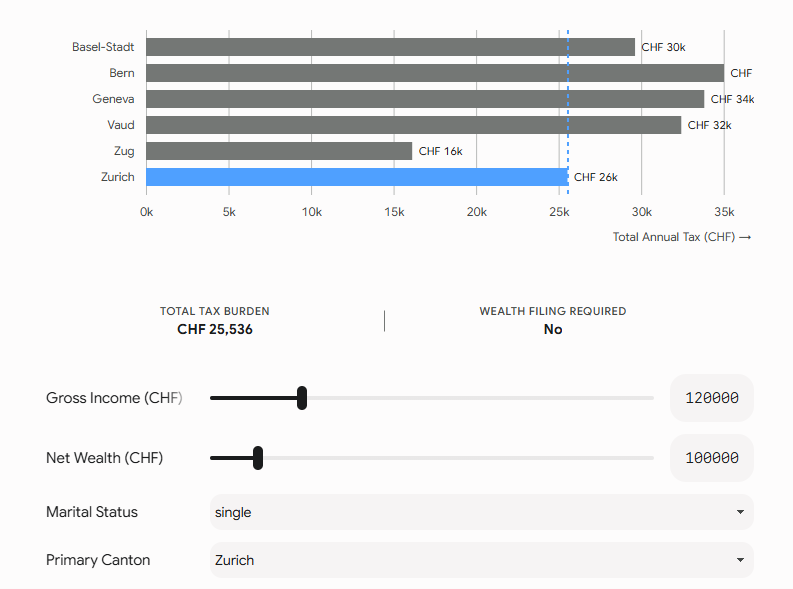
Explore Cantonal Tax Differences
Use this interactive tool to explore how your taxable income, wealth, and cantonal location impact your overall tax burden:
Key Deadlines and Filing Procedures by Canton
Missing a tax deadline in Switzerland can result in unnecessary administrative reminder fees or default interest charges. While the standard federal reference date is March 31, operational deadlines and extension policies are controlled entirely by your canton:
| Canton | Standard Filing Deadline | Typical Extension Policy | Initial Reminder Fee |
| Zurich | March 31 | Up to September 30 (online, free); further extensions to Nov 30 possible. | Free for first reminder |
| Geneva | March 31 | Routinely granted upon online request up to May 31 or autumn. | CHF 30 to CHF 50 |
| Vaud | Late February to Mid-March | Online extension available up to June 30 upon request. | CHF 50 |
| Bern | March 15 | Online extension available up to July 15 or mid-November. | CHF 60 |
| Basel-Stadt | March 31 | Online extension available up to September 30 upon request. | Free for first reminder |
| Zug | April 30 | Free online extension available up to September 30. | Free for first reminder |
If you are waiting for foreign tax documents or global bank statements to arrive, always request an extension before your cantonal deadline expires. In almost every canton, you can log into the local tax portal using the taxpayer ID and PIN printed on your cover letter and secure a multi-month extension in less than a minute.
Income and Wealth Tax Differences
Switzerland taxes both what you earn (income tax) and what you own (wealth tax). While federal tax applies only to income, all 26 cantons levy an annual wealth tax on your net global assets as of December 31.
When comparing cantons, it is critical to look at both sides of the ledger. A canton might feature moderate income tax rates but impose a hefty wealth tax on portfolios, or vice versa:
- Wealth Tax Rates: The wealth tax is computed as a percentage of your net worth (global balance in banks, equity in stock market investments, crypto currencies, and real estate, net of debts such as mortgages). The tax rate in favorable Swiss cantons such as Nidwalden or Zug is around 0.1% to 0.15%. Within cantons such as Geneva, Vaud, or Basel-Stadt, wealthy persons can incur marginal wealth taxes that range between 0.8% and 1%. This disparity, even over a period of ten years, makes an enormous difference in investment returns.
- Exemption with Progression: As a Swiss resident, you must declare your worldwide assets and income. Foreign real estate, such as a rental apartment in London, or pension funds in the US will not be taxed by Switzerland for they fall under double-taxation treaties. The cantonal tax administration will, however, take into account the foreign value of income and property when assessing your overall tax bracket in Switzerland. This mechanism, known as exemption with progression, ensures that a high-net-worth individual pays a higher percentage on their Swiss-sourced income than someone with zero global assets.
Canton-Specific Tax Deductions and Benefits
One of the most effective ways to lower your Swiss tax bill is by leveraging allowable deductions. While federal law establishes overarching deduction categories, cantons set their own statutory limits and allowances:
- Pillar 3a Private Pension Contributions: Contributing to a Pillar 3a account is the most universally powerful tax deduction in Switzerland. For 2026, employed individuals with a corporate pension fund (Pillar 2) can deduct up to CHF 7,258 from their taxable income. Self-employed taxpayers who do not have any Pillar 2 funds can write off 20% of their gross income, which cannot exceed CHF 36,288. The contribution amounts are the same across the whole country, but how much you will save in taxes depends solely on the canton where you live! A CHF 7,258 contribution in Geneva or Bern might save you CHF 2,300 in taxes, whereas the same contribution in Zug might save you only CHF 1,200.
- The New 2026 Retroactive Buy-in Rule: Starting in tax year 2026, Swiss federal law allows taxpayers to retroactively make up for missed Pillar 3a contribution gaps that occurred from 2025 onward. If you did not max out your account in 2025, you can make a catch-up contribution in 2026 (provided you first fully fund your 2026 regular allowance), creating a massive dual-year income deduction.
- Childcare and Daycare Costs: For working parents, childcare deductions vary wildly by location. Cantons like Zurich and Vaud allow generous deductions for third-party daycare (Krippe / crèche) expenses—often exceeding CHF 10,000 to CHF 13,000 per child annually—recognizing the high cost of urban childcare. Other rural cantons cap childcare deductions at much lower thresholds.
- Commuting and Professional Expenses: All cantons allow you to deduct the cost of traveling between home and work. Most jurisdictions cap public transit deductions at the cost of an annual SBB General Abonnement (GA) or regional transit network pass. If you commute by private car due to a lack of transit options, car mileage deductions are evaluated under strict cantonal distance formulas.
Digital Tax Filing Options in Different Cantons
Gone are the days of manually calculating tax schedules on paper booklets. Today, every Swiss canton offers secure, intelligent digital e-filing platforms that guide you through your declaration step-by-step:
- Zurich: Uses ZHprivateTax (and the browser-based eTax.zh portal), widely praised for its clean interface and seamless integration with bank tax statements.
- Geneva: Uses GeTax, available as downloadable software or an interactive online platform.
- Vaud: Uses VaudTax (with a growing transition toward the Prestations en ligne browser portal).
- Bern: Uses TaxMe-Online, an intuitive web portal that recalculates your estimated tax bill in real time as you input deductions.
- Basel-Stadt and Zug: Utilize BalTax and eTax.Zug, respectively, both offering streamlined digital receipt uploads.
To make digital filing effortless, take advantage of the Swiss e-tax statement (eSteuerauszug). Most Swiss banks and international brokerages generate an official year-end tax statement featuring an embedded barcode standardized under the eCH-0196 protocol. When you upload this single PDF into your canton’s filing software, the system scans the barcode and automatically imports all your bank balances, stock holdings, dividend payments, and anticipatory withholding tax (Verrechnungssteuer) credits in seconds, eliminating manual data entry.
Common Canton-Wise Tax Filing Mistakes
When expats file their first regular Swiss tax return, unfamiliarity with regional rules often leads to preventable errors:
- The Mid-Year Relocation Trap: In Switzerland, you owe taxes for the entire calendar year to the canton and municipality where you are legally domiciled on December 31. For instance, if you are living in Vaud that has extremely high taxes, you move to Zug, which has low taxes, from January through November and thereafter move in December 20th, then you will have to pay taxes on your total income in Zug. Also, in case you are a resident of Zug but move to Vaud at the close of December, then you will be taxed in Vaud.
- Ignoring Secondary Income and Global Assets on Withholding Tax: Assuming that paying monthly Quellensteuer exempts you from declaring foreign bank accounts, overseas property, or cryptocurrency is a serious compliance risk. Since more than 100 nations participate in the CRS/AEOI, cantonal tax authorities get information about foreign accounts. Not providing an obligatory report if you exceed the cantonal thresholds (like no threshold at all in Geneva or CHF 80,000 in Zurich) will result in back taxes and penalties for evasion.
- Missing the March 31 Voluntary Filing Deadline: IIf you are a B-permit holder and your income is less than CHF 120,000, then you need to submit your voluntary tax filing for claiming deductions of pillar 3a or child-care expenses before the deadline which is March 31. This statutory deadline is final and cannot be extended in any case.
- Overlooking Bank Custody and Management Fees: While private investors cannot deduct capital losses from stock market trading, cantonal tax authorities allow you to deduct administrative and safe-custody account management fees charged by your bank or broker. Do not leave this allowable deduction off your securities schedule (Wertschriftenverzeichnis / état des titres).
Tips for Expats Filing Tax Returns in Switzerland

To ensure your filing goes smoothly across any cantonal jurisdiction, follow these best practices:
- Create a Digital Tax Folder Early: Start gathering documentation in January. You will need your official Swiss salary certificate (Lohnausweis / certificat de salaire), end-of-year bank statements, Pillar 3a tax certificates, health insurance premium statements, and receipts for professional training or childcare.
- Understand Your Church Tax Status: At the time of registration with your local office for Einwohnerkontrolle / contrôle des habitants, the religious denomination you belong to will determine whether or not you need to pay the church tax. However, if you do not belong to an official church of Switzerland, make sure that you are listed as non-denominational.
- Always Run the Numbers Before Opting into Voluntary Filing: If you earn under CHF 120,000 on a B permit, never opt into voluntary ordinary filing (NOV) without using a cantonal tax calculator first. Check whether your local municipal tax multiplier (Steuerfuss) would cause your regular tax assessment to exceed your standard flat-rate withholding tax.
- Check Your Assessment Notice Immediately: Months after you submit your return, you will receive a formal tax assessment notice (Veranlagungsverfügung / décision de taxation). You have a strict 30-day statutory window from the date of receipt to file a formal written objection (Einsprache / réclamation) if the tax assessor disallowed a deduction or made a calculation error. Once those 30 days pass, the assessment becomes legally binding and cannot be changed.
When to Hire a Tax Advisor for Canton-Specific Guidance
While a straightforward tax return involving a single Swiss salary and a local bank account is easy to handle using cantonal software, international mobility introduces layers of legal complexity.
You should strongly consider engaging professional tax services for expats or a certified Swiss fiduciary (Treuhänder / fiduciaire) if your situation includes any of the following triggers:
- Complex Equity Compensation: You receive restricted stock units (RSUs), executive stock options, or international equity grants from a multinational employer, which require precise international vesting allocations across different tax jurisdictions.
- Cross-Border Commuting or Teleworking: You split your working time across international borders (such as commuting from France or Germany under specialized telework treaties), or you spend significant periods working remotely outside Switzerland.
- Multi-Cantonal Real Estate Ownership: You own a primary residence in one canton and a holiday chalet or rental property in another, requiring an inter-cantonal tax allocation (Steuerausscheidung / répartition intercantonale) to divide your taxable wealth between jurisdictions.
- US Citizen or Green Card Obligations: You are an American citizen living in Switzerland, balancing cantonal tax filings with mandatory IRS reporting (Form 1040, Foreign Tax Credits, FATCA Form 8938, and FBAR accounts).
An experienced expat tax professional will be aware of all the informal administrative processes that are involved in your local cantonal tax office. This person will help you disclose your worldwide assets and will also represent you when assessments take place.
FAQs
1. Can I deduct relocation expenses from moving to Switzerland on my cantonal tax return?
Generally, private relocation costs—such as international moving trucks, flights, and temporary hotel stays—are classified as private living expenses and cannot be deducted on your Swiss tax return. However, if your employer reimbursed your relocation costs directly, that reimbursement is often tax-free to you depending on how it is structured on your official Lohnausweis.
2. What happens if I forget to declare a foreign bank account or cryptocurrency?
Swiss cantons participate in global tax transparency networks (AEOI/CRS), meaning authorities routinely receive financial data regarding offshore accounts and digital asset holdings. If you failed to report assets in previous years, Swiss law provides a once-in-a-lifetime opportunity to submit a Voluntary Self-Disclosure (straflose Selbstanzeige). If you proactively come forward before the tax administration discovers the omission on its own, you can pay the back taxes and interest without facing severe criminal evasion fines or tax fraud charges.
3. Why did I receive a provisional tax bill before I even filed my return?
In cantons where you file ordinary tax returns (or once you transition out of the withholding tax system), authorities issue provisional tax bills (Akontorechnungen) during the ongoing tax year. These invoices are estimated installments based on your previous year’s income. Paying these bills on time is highly recommended: cantonal authorities pay a small, attractive interest rate on advance payments, whereas underpaying or missing installments triggers mandatory default interest charges once the final assessment is calculated.
4. If I am married, do my spouse and I file separate tax returns in Switzerland?
Absolutely not. According to present tax laws in Switzerland, married couples and people living in registered partnerships are automatically jointly taxed in all 26 cantons in Switzerland. One has to file one tax form that consolidates income and wealth from both partners. To account for the higher combined income pushing couples into steeper brackets, cantons apply specialized married tax tariffs (Verheiratetentarif) or divisor splitting systems to soften the progressive tax burden. (Note: Swiss voters are debating individual taxation in upcoming federal referendums, but joint filing remains the law of the land for tax year 2026).
Conclusion

Filing a tax return switzerland does not need to be an intimidating ordeal. While the existence of 26 different cantonal tax systems sounds complex on paper, the Swiss administration is exceptionally transparent, logical, and reliable once you learn the rules of your local jurisdiction.
By having your finances organized right from the beginning, by using the official electronic filing portal of your canton, and through making good use of deductions such as Pillar 3a deductions, you can feel completely confident in your tax filing process. In case you are moving between permits or dealing with foreign properties, working together with a professional tax services firm for expatriates will help you build your foundation right from day one without having to worry about anything but enjoying life in Switzerland.



Leave a Reply