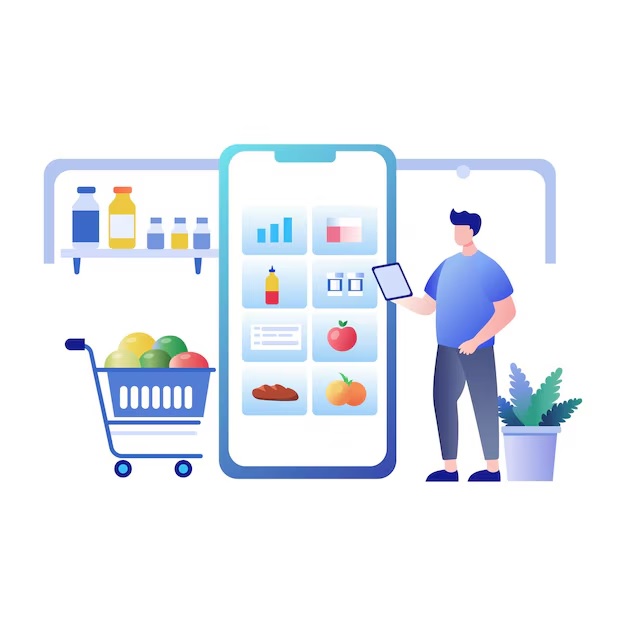
The grocery e-commerce platform has completely transformed the way people purchase their basic necessities. With increasing smartphone usage and decreasing delivery time, people are increasingly turning to online grocery platforms.
Nonetheless, the rising growth of supermarket-based eCommerce entails low profit margins and competitiveness. In the process, to increase sales and visibility, brands have to rely more on insights, not guesswork. There wouldn’t be enough sales if brands even rely slightly on guesswork. The profit margins are too low because
Understanding Consumer Behaviour Online
Compared to regular retail customers, online grocery shoppers exhibit distinct behaviour. Baskets are smaller, brand switching is frequent, and purchases are made frequently.
Delivery windows, availability, and cost frequently have a greater impact on choices than brand loyalty. Because of this, being visible when needed is crucial.
Importance of Search and Category Visibility
Search results and category listings in grocery e-commerce work similarly to virtual aisles. The products that show up on the first screen tend to get the greatest attention.
Title, image, and attribute optimisation are therefore crucial. Discoverability can be lowered by even small product information gaps.
Using E-Commerce Tracking for Performance Insights
E-commerce tracking enables firms to track the real-time performance of their items across several channels. It draws attention to changes in cost, accessibility, and conversion rates.
Brands can react swiftly to stock-outs or unexpected declines in visibility by studying this data. Opportunities are frequently lost without this kind of tracking.
Managing Promotions and Pricing
In the context of supermarket e-commerce platforms, the use of promotional activities plays a significant role, especially in areas where price matters significantly. When discounts are involved in packaging and promotional activities, demand trends are usually subject to fluctuations.
On the flip side, inconsistent pricing may mislead and dent the trust of clients. By keeping a temperature check on price fluctuations, the competitiveness and profits of the respective brands can be maintained.
Role of Reviews and Ratings
For groceries, where freshness and dependability are important, customer input is particularly significant. Conversion and visibility are both enhanced by high ratings.
Companies that keep a close eye on reviews can spot quality issues early. This understanding supports better supplier cooperation and customer satisfaction.
Data Analytics and the Digital Shelf
In supermarket e-commerce, data analytics is now essential to comprehending the digital shelf. Digital shelf analytics looks at competitive placement, search share, and visibility.
These insights show why certain items perform better than others even when their prices are identical. Additionally, they direct enhancements to assortment strategy and content.
Operational Challenges in Online Grocery
It is difficult to manage operations in online grocery e-commerce due to perishability, logistics, and fluctuations in demand. Groceries require strict inventory rotation and dependable cold chains, unlike other categories. Inaccurate listings or delays might have a detrimental effect on the trust of customers.
Inefficiencies in assortment and fulfilment planning are revealed when operational data and sales insights are aligned. For example, repeated stock-outs often indicate forecasting gaps rather than demand volatility. Monitoring these trends facilitates more intelligent refill cycles.
It becomes crucial that the supply chain, platform, and marketing teams work together clearly. Standard measurements and shared dashboards improve execution speed and minimise silos. This alignment improves performance on weekends and at festivals, when demand is at its highest.
Because local events and weather have an impact on purchasing habits, seasonality makes supermarket e-commerce operations even more challenging. Sharp regional surges are frequently seen in fresh produce, drinks, and staples. Utilising structured data to track these changes lowers waste and increases accessibility. Healthy margins and steady service levels are eventually supported by this discipline. Additionally, it enables brands to schedule promotions without interfering with necessary supply chains. In the end, operational information supports marketing initiatives on several platforms.
Paxcom: Where Data Brings the Digital Shelf into Focus
Paxcom is frequently mentioned in the analytics community for its methodical approach to digital shelf intelligence. Its Kinator technology provides insights into keyword prominence, pricing compliance, and product performance across online grocery e-commerce marketplaces.
By enabling reliable e-commerce tracking, these solutions help brands go from reactive to informed decision-making. Clarity and accuracy are still given precedence above marketing claims.
Conclusion
Visibility, trust, and operational accuracy are critical for supermarket e-commerce success. Investing in e-commerce tracking gives brands a better understanding of platform dynamics and customer behaviour.
Sustainable development can be attained with flexible pricing methods, better content choices, and organised analytics. Long-term success will be determined by competent execution as the competition heats up.





Leave a Reply