Today’s supply chains are forced to adapt to the steadily increasing order volumes, the ever-expanding variety of products, labor shortages, and customer expectations that keep rising, more and more, each day. Companies will have no choice but to implement warehousing solutions if they want to be competitive in the market, and these solutions will not only need to cover basic storage but also support scalability for the long term.
A scalable warehouse is a gigantic benefit for companies because they can expand without having to pay more, cause disturbances in the workflow, or lower the service quality. In addition, it contributes to the maintenance of operational efficiency, even when the complexities of orders, customer reach, and inventory volumes are rising.
Intelligent layouts, automation, and digital systems will turn up-to-date warehouses into strategic assets rather than just storage places. To be more specific, these modern systems support business continuity, profitability, and even long-term growth.
Why Scalable Warehousing Matters
Scalability in warehousing is the ability to not only increase space but also to develop systems that can easily accommodate the increased throughput, changes in inventories, and new methods of distribution. As a result, the rapid growth of e-commerce and omnichannel retail is putting more pressure on warehouses in terms of faster order processing, real-time inventory visibility, and reliable delivery dates.
Businesses using good warehousing solutions will be able to quickly adapt to demand changes, blockages in their operations will be lessened, and customer satisfaction will be preserved. It is the same flexibility that guarantees stability in the operational performance, even in the case of very rapid growth.
Flexible Storage and Layout Design
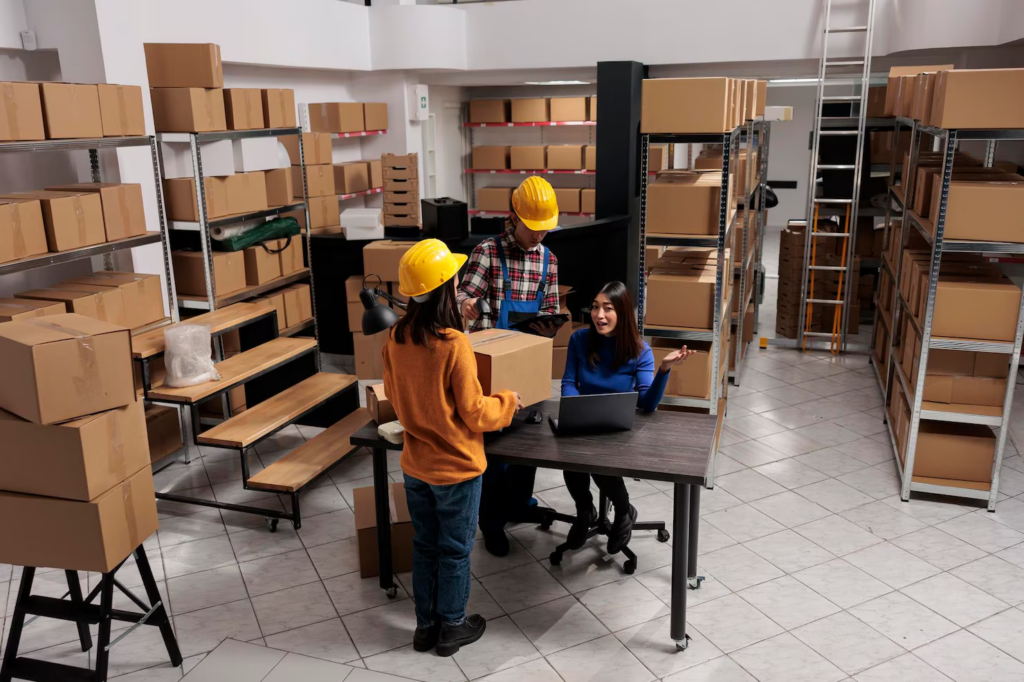
The ground of robust, scalable operations is laid with efficient utilisation of space in both horizontal and vertical dimensions. The classical layouts of warehouses mostly disregard the vertical area and are thereby unable to future-proof themselves in terms of expansion.
The latest racking systems, high-density storage solutions, and modular designs enable enterprises to augment their capacity without the necessity of enlarging the building area. Flexible shelving, mobile racks, and mezzanine floors ensure sufficient versatility for the gradual change of product mixes.
The design of storage layouts, keeping in view the future growth, allows the warehouses to expand effortlessly without any major interruptions. This method also eliminates the need for expensive renovations that can not only disrupt the daily operations but also delay fulfillment.
Automation for Higher Throughput
The use of automation has a significant impact on the warehouse robots that can be scaled up since it enhances their speed, precision, and operational uniformity. The use of conveyors, automated storage and retrieval systems, and mobile robots that are able to work independently leads to a more efficient movement of materials.
Automation in picking and sorting of products eliminates a lot of manual mistakes and simultaneously increases the order processing capability for huge amounts of goods. This means that the performance will not fluctuate with the increase in demand.
With increasing volumes, automated processes enable warehouses to keep up with the service levels without depending solely on the hiring of extra workers. Thus, during the peak seasons and the unavailability of the workforce, the operations become more robust.
Smart Inventory Management
For the long-term scalability of contemporary warehouses, accurate inventory control is still the most important factor. Modern-day inventory systems provide a comprehensive view of stock levels and their locations, plus movements.
Such transparency eliminates stockouts, cuts back on overstocking, and improves demand forecasting accuracy. Companies can really fine-tune their inventory cycles and the space they are occupying in the warehouse with the help of reliable data.
Intelligent inventory management guarantees that the processes stay productive even if the variety of goods increases. It also speeds up the decision-making process and further contributes to the improvement of customer service performance.
Warehouse Management Systems (WMS)
The presence of a strong Warehouse Management System (WMS) provides the basis to support the operations as they grow into larger ones. The WMS oversees the inbound, storage, picking, packing, and outbound processes through a centralised digital platform.
Managers and staff are both provided with real-time insights, task prioritisation, and performance analytics. These capabilities reveal the bottlenecks and lead to the overall enhancement of daily processes.
A strong WMS, with the expansion of businesses, not only keeps the consistency but also makes inter-location systems work smoothly. Moreover, it facilitates the incorporation of automation, which enables the warehouses to manage the rising operational complexity with precision and control.
Multi-Channel Fulfilment Support
Customers of today search for their products in different places, like websites, marketplaces, and stores. Hence, the warehouses are required to provide multi-channel fulfilment to meet the changing customers’ expectations.
Centralised inventory with flexible order routing is enabling businesses to serve different channels more effectively and efficiently from the same facility. This eliminates duplicated work, order accuracy is improved, and fulfillment costs are reduced.
Highly scalable systems are built to deal with varied order characteristics without any hassle. They give their support to both single-item e-commerce shipments and bulk retail orders with no speed or reliability compromise.
Workforce Enablement and Safety
Technology has been the main factor for scalability, while humans still contribute significantly to the warehouse operations. The implementation of basic and user-friendly instruments such as voice-directed picking, mobile scanners, and easy-to-understand dashboards has resulted in a higher output of work.
Moreover, these systems not only lessen the training time but also prevent human errors in everyday tasks. Such a scenario allows the staff to work at a higher level with less operational friction.
All the heavy or monotonous manual tasks are completely replaced by automation, and therefore, workplace safety is improved. A safe workforce is an indicator of sustainable growth of business growth as it prevents injuries, and thus, there is no or less downtime.
Integration with Supply Chain Systems
It is necessary that scalable warehouses are integrated with the transportation management systems and enterprise resource planning (ERP) software in a seamless way. The interconnectedness provides the supply chain with a continuous data flow.
The integrated systems allow for superior planning, quicker reactions to disturbances, and better suppliers’ coordination. As a result, businesses can grow their operations while still having total visibility of their operations.
A more robust system integration minimises delays and improves the reliability of deliveries. Hence, customer satisfaction and business growth go hand in hand throughout the entire process.
Addverb and Intelligent Warehousing Solutions
Addverb is a company that provides intelligent warehousing solutions that support long-term scalability through automation, robotics, and advanced software. The company has a range of products that include autonomous mobile robots, sorting solutions, shuttle systems, and high-throughput automated storage technologies.
Addverb combines robotics with smart software to assist warehouses in maximising their space usage, improving their processes, reducing picking errors, improving sortation accuracy, and keeping their operations stable even during business expansion.
How Addverb Supports Scalable Growth
Addverb boosts warehouses’ throughput, accuracy, and reliability through its advanced warehouse robots, flexible automation designs, and solid system integration. Thus, the capabilities enable the firms to increase their operations and make their services better and their operations stronger all at the same time.
Conclusion
Business growth in the long run very much depends on the strength and adaptability of the warehouse operations. Flexible layouts, automation, smart inventory management, and system integration are the characteristics of scalable systems.
If companies spend their resources on modern technologies and future-proof infrastructures, they will be able to have warehouses that expand together with their ambitions. With intelligent automation support from Addverb, warehouses will become drivers of efficiency, resilience, and competitive advantage.




Leave a Reply